 AlphaWhisper
Gravity
The map dealers are hedging against
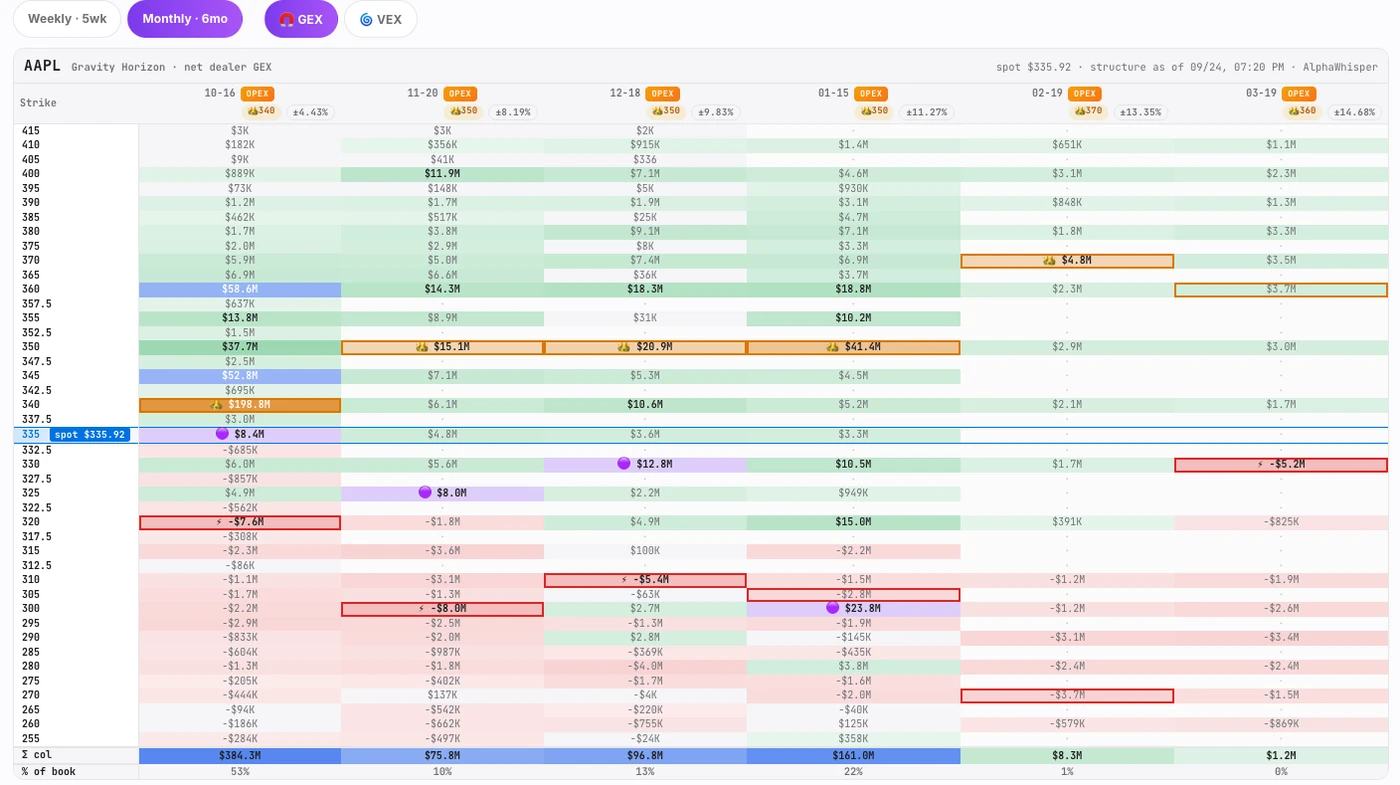
Market makers are short the options you buy, and they hedge that exposure by trading the underlying. Where they are heaviest, price gets pulled. Where they are thin, it runs. Gravity draws that surface across every strike and every expiry, rebuilt continuously while the market is open.
Basic covers SPX, SPY and QQQ. Pro and Ultimate cover every ticker.
The questions it exists for.
- Where is price likely to be rejected today, and where is it likely to be caught?
- Which strikes are dealers actually defending, and with how much money?
- Has the structure changed since yesterday, or is the map holding?
- Is today a day when hedging absorbs moves, or one when it extends them?
What you are actually looking at.
The king node
The single strike carrying the heaviest dealer exposure. Price tends to gravitate back toward it and often pins near it into an expiry.
Floor and ceiling
The nearest heavy positive levels below and above. Dips into a floor tend to get bought by hedging, rips into a ceiling tend to get sold.
The flip
Where net exposure changes sign. Above it, hedging usually dampens moves. Below it, hedging usually amplifies them, which is why ranges break down there.
Air pockets
Strikes with almost no dealer interest. Price crosses them fast because nothing is hedging against the move.
The honest limit.
Gravity tells you where the structure sits, not what will happen. A wall is a place where a move is more likely to stall, not a guarantee that it will. Heavy positioning can and does get run through, usually on news the map never saw.
The rest of the desk, reading the same tape.






Fourteen days free. No card.
You are inside in under a minute, with the whole Pro desk.