 AlphaWhisper
Congress trades
Who bought what, and how it went
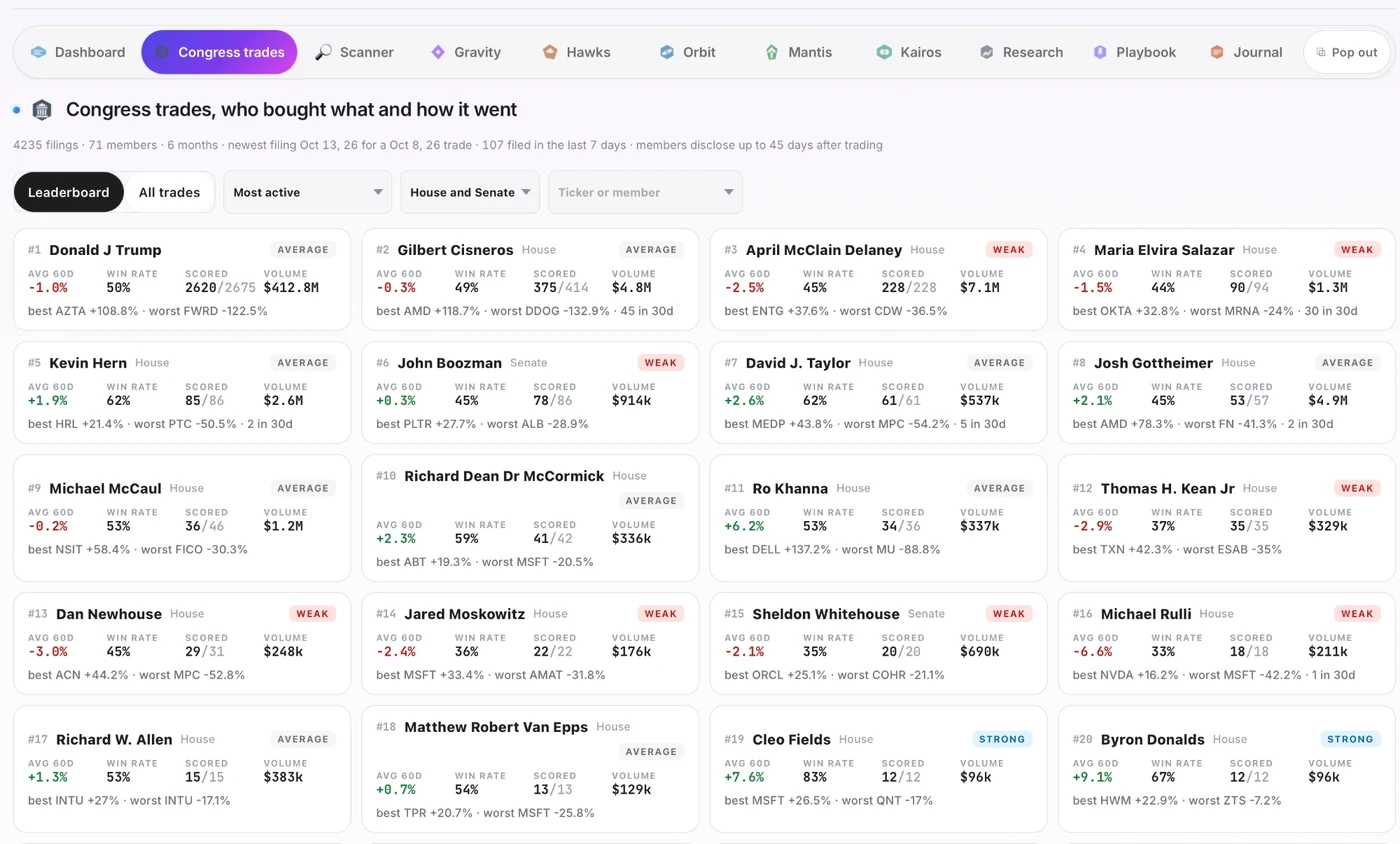
Members of the House and Senate must disclose their stock trades, and they do, up to 45 days late and in a format nobody reads. We read it. Every filing lands here with the trade graded against what the stock did next, so a member is ranked on the record, not the headline: 4,235 filings from 71 members over the last six months, 107 of them in the past week.
The questions it exists for.
- Which members actually make money when they trade, and which just trade a lot?
- Who bought this ticker in the last month, and what happened to it?
- What was filed this week, and how old are the trades behind the filings?
- Is a member's record strong enough to be worth following at all?
What you are actually looking at.
The leaderboard
Every member with scored trades, ranked by the 60-day return, with the win rate, how many trades were scored, the dollar volume, the best and worst call, and a STRONG, AVERAGE or WEAK grade that comes from the numbers.
All trades
The full tape of filings, filterable by House or Senate, by ticker or by member, most active first, each one with the trade date, the filing date and the gap between them.
The lag, stated
Members may disclose up to 45 days after the trade. The header says when the newest filing arrived and which trade it describes, so you never mistake a six-week-old purchase for news.
Grading
Trades are graded the same way our own agents are: against the price that followed, with the losers kept in the record.
The honest limit.
A disclosure is a lagging fact, not a signal. By the time a filing appears the trade can be weeks old and the move may already be over. A strong record over six months is a small sample, and a member with twelve scored trades is not a track record. Use this to understand positioning, not to copy it.
The rest of the desk, reading the same tape.
 Command DeckLog in. Know the day. In ninety seconds
 GravityThe map dealers are hedging against
 HawksTwenty thousand prints today, the three that mattered
 OrbitThe chart that is also the desk
 ScannerThe whole market, on your conditions
 MantisSwings that only fire when the structure agrees
 JournalYour trades, and what they actually taught you
 RavenAsk the desk a question
Fourteen days free. No card.
You are inside in under a minute, with the whole Pro desk.